









Trees are the most valuable things on most properties, and the most misunderstood. A mature pohutukawa in the right spot adds real value to a site. The same tree, planted three metres from a building foundation, becomes an insurance claim waiting to happen. The skill is knowing the difference, and knowing what you are actually allowed to do about it.
Most of the tree calls we get from property managers come down to one of three decisions. Prune it, remove it, or protect it. Here is how we think about each.
The three decisions every property faces
When we walk a site with a client, we are essentially answering three questions about every significant tree.
- Is this tree healthy, well placed and contributing to the property? If yes, the answer is usually pruning, monitoring and protection.
- Is this tree a risk to people, buildings or services that cannot be managed by pruning alone? If yes, removal needs to be on the table.
- Are there legal protections on this tree that change what we can do? In Auckland, the answer is more often yes than people expect.
Get those three questions right and the rest of the work is straightforward.
When pruning is the right call
Pruning is the default answer for any healthy tree. The trick is knowing which type of pruning, and when.
Signs a tree needs work
- Branches rubbing the building, blocking gutters, or hanging over a driveway low enough to scrape a delivery truck.
- Crossing or rubbing limbs inside the canopy, which create wounds and entry points for decay.
- Dead wood larger than a wrist, which becomes a falling-limb risk in the next southerly.
- Sucker growth from the base, water shoots along main limbs, or lopsided weight that has developed since the last prune.
- Encroachment on power lines (Vector has its own clearance requirements in Auckland and you do not want to be the property owner who got served a notice).
Seasonal timing in NZ
We are in the Southern Hemisphere, so the rules you read on overseas gardening sites do not always apply.
- Late autumn through winter (May to August) is the main structural pruning window for most deciduous trees. The tree is dormant, the wounds heal cleanly, and you can actually see the structure.
- Late spring and early summer is fine for light shaping and clearance work on most evergreens.
- Avoid mid-summer heavy pruning. A big cut in February stresses the tree right when it is working hardest.
- Natives are their own conversation. Pohutukawa, kowhai and puriri all have different timing. Pohutukawa in particular do not respond well to heavy pruning right before flowering.
Structural vs. clearance pruning
These are two different jobs and a lot of cowboy operators confuse them.
Structural pruning is about the long-term shape and health of the tree. Removing crossing limbs, encouraging a single dominant leader, balancing the canopy. Done early in a tree’s life, it prevents 90 percent of the problems people pay to fix in the next decade.
Clearance pruning is about getting the tree out of the way of buildings, lines, vehicles and pedestrians. It is responsive work, and it should still be done with the long-term shape of the tree in mind.
A good arborist does both in the same visit. A bad one just topples the tree off, leaves stubs, and you end up with a worse tree two years later.
When removal is necessary
Removal is the right call less often than property managers expect, but when it is right, it is right.
Real reasons to remove a tree
- Disease that cannot be managed. Myrtle rust on a ramarama, kauri dieback on a kauri, advanced honey fungus, large cavities with active decay. We assess these case by case.
- Structural failure risk. Major split unions, included bark, large dead leaders, root plate movement after a storm. Some of these can be reduced with cabling or selective pruning. Some cannot.
- Proximity to buildings. A large tree planted too close to a foundation, with roots actively lifting paths, slabs or stormwater pipes, often has to come out before the repair bill exceeds the cost of replacement.
- Power lines. If the tree cannot be brought into clearance without destroying it, removal is more honest than slow strangulation.
- Infrastructure damage. Roots in sewer laterals, lifted kerbs, cracked retaining walls. Sometimes these can be managed. Sometimes they cannot.
The honest answer is that a lot of trees get removed for the wrong reasons (someone does not like the leaf drop) and a lot of dangerous trees get left standing because nobody wanted to spend the money. A qualified arborist will tell you which one you are looking at.
Tree Protection Orders in Auckland
This is the part that catches commercial property managers out, so pay attention.
Under the Auckland Unitary Plan, a tree on your property may be protected if it is:
- A Notable Tree (individually scheduled in the plan).
- Within a Significant Ecological Area (SEA).
- A scheduled tree under historic district plan provisions that still apply.
If any of those apply, you cannot prune more than the standard maintenance allowance, and you absolutely cannot remove the tree, without resource consent from Auckland Council. The fines for getting this wrong start in the thousands of dollars and go up sharply.
There are also general protections for native trees on certain zones and parcels. Always check before any major work.
A proper tree care contractor will run the check for you before quoting, lodge the consent if needed, and engage an arborist to write the supporting report. We do this regularly and it is a normal part of commercial tree work in Auckland.
Why a qualified arborist matters
Tree work is genuinely dangerous and genuinely skilled. The difference between a NZARB-aligned arborist and a man with a chainsaw and a ute is not marketing. It is whether your tree is still alive in five years, whether the council prosecutes you, and whether anyone gets hurt on the day.
Look for:
- NZ Arboricultural Association membership or alignment.
- A real qualification (NZQA Level 3 minimum, ideally Level 5 or above for any climbing work).
- Public liability insurance specifically covering arboricultural work.
- A written quote that distinguishes the work from clean-up and disposal.
If somebody offers to “top” your tree, walk away. Topping is not pruning. It permanently damages the tree and creates a more dangerous structure than the one you started with.
How we work
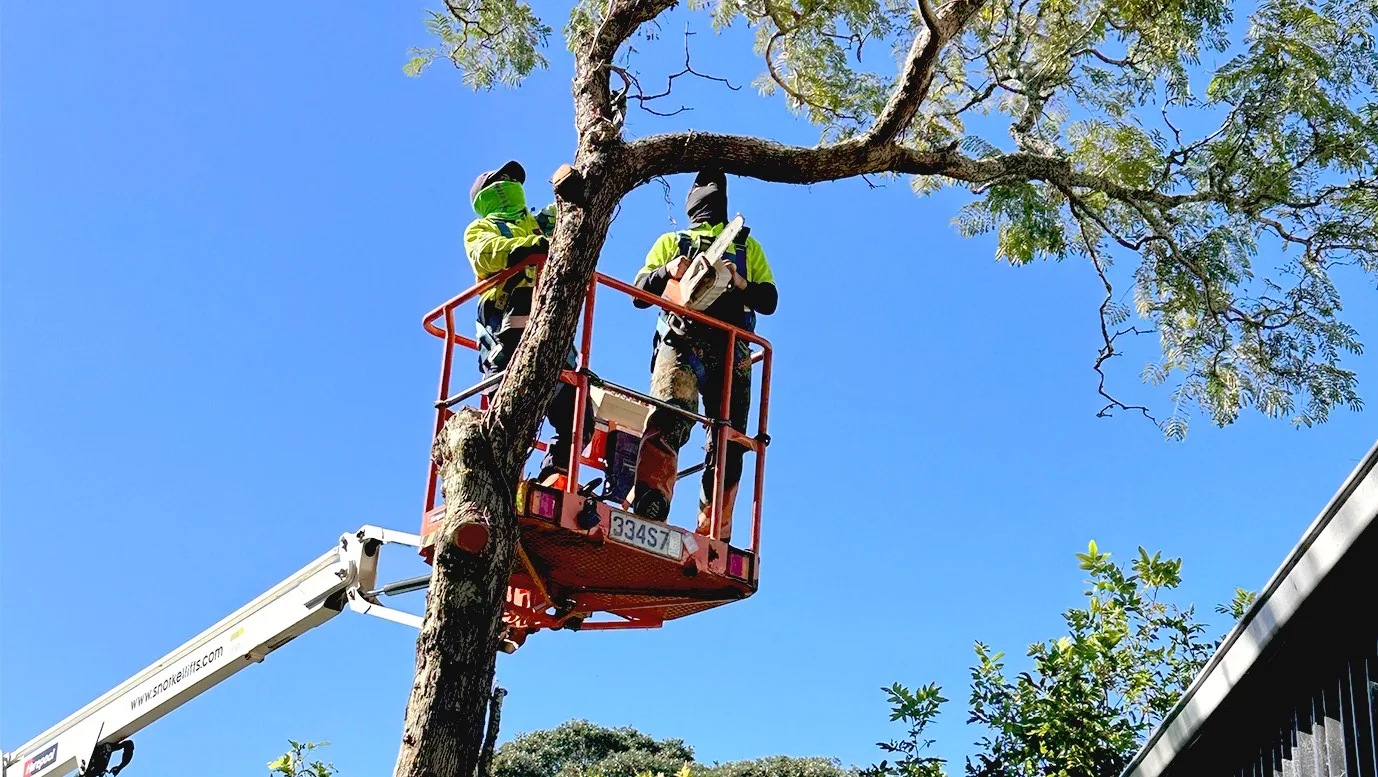
Our tree care team is NZARB-aligned and works across Auckland, on everything from single-tree clearance jobs at private homes to multi-tree assessments on commercial sites and body corp properties. We can walk a property with you, write up an honest assessment of which trees need work and which need to be left alone, lodge any consent applications required, and do the work itself.
We are happy to take on one-off jobs and we look after a lot of properties on ongoing tree care plans, where we inspect the trees once or twice a year and stay ahead of the problems.
Talk to us about your trees
If you have a tree you are unsure about, or you have inherited a property and want a proper assessment of what is on it, we are happy to come out and have a look.
Get in touch through our contact page or call the office on 027 286 9210.